Overview
Top Panel
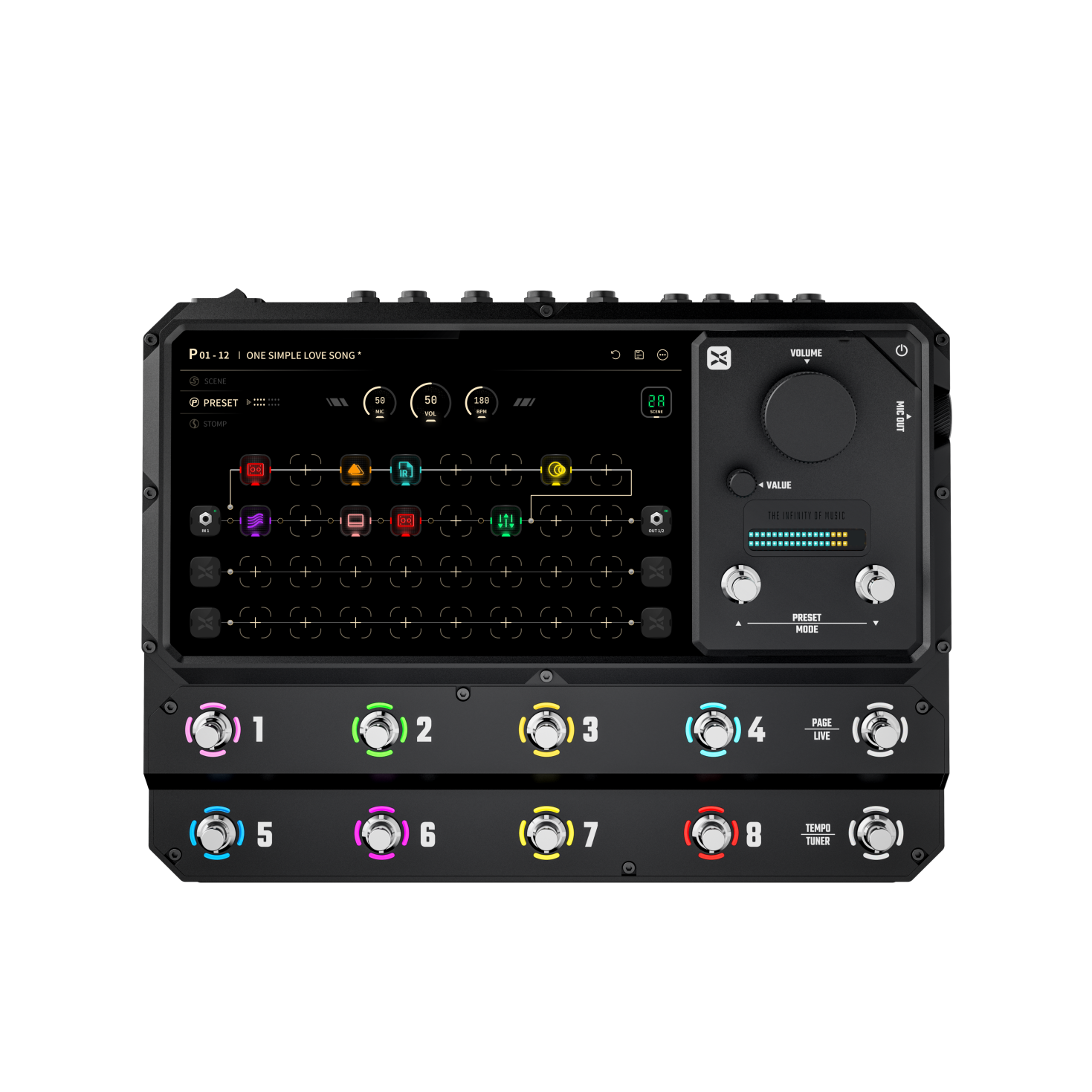
- 10-inch touchscreen
- Footswitches 1–8 (assignable)
- PAGE/LIVE footswitch
- TEMPO/TUNER footswitch
- PRESET/MODE footswitches (2)
- Master Volume knob
- Mic Out knob
- Global Value knob (VALUE)
- Level meters
- Screen On/Off button
XR1 has 12 footswitches in total.
Rear Panel
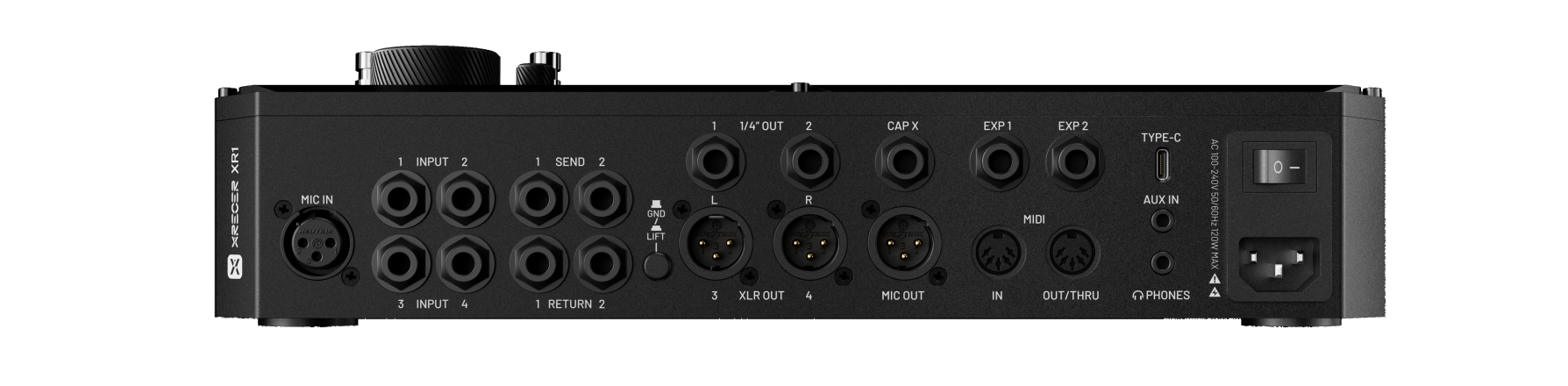
- INPUT 1–4: 1/4-inch instrument inputs. INPUT 1/2 and INPUT 3/4 can each be paired as a stereo input.
- MIC IN: XLR microphone input with switchable +48 V phantom power.
- SEND 1/2: FX loop sends, for connecting external pedals or another amp.
- RETURN 1/2: FX loop returns.
- GND LIFT: ground-lift switch for reducing ground-loop noise.
- OUT 1/2: 1/4-inch balanced outputs.
- OUT 3/4: XLR balanced outputs.
- MIC OUT: XLR balanced microphone output.
- CapX Output: 1/4-inch output used for tone capture. See CapX.
- EXP 1/2: expression pedal inputs (TRS, dual-channel).
- MIDI IN / MIDI OUT: 5-pin MIDI input and output. MIDI OUT can also act as THRU.
- USB-C: 16-in/16-out USB audio interface with MIDI.
- AUX IN: 3.5 mm auxiliary input.
- PHONES: 3.5 mm headphone output.
- Power: power switch and AC inlet.
For levels and impedances, see I/O Specifications.
Key Terms
- Signal Chain: the path your sound takes from an input, through the effects, to an output. XR1 runs up to four Signal Chains (paths) at once.
- Preset: a complete Signal Chain setup with all its effects and settings.
- Patch: a group of 16 Presets. Preset P01-12 is Preset 12 in Patch 01.
- Scene: a snapshot of parameter settings inside one Preset. Each Preset holds up to 16 Scenes.
- Stomp: an effect assigned to a footswitch, so you can turn it on and off like a pedal.
- Combo: a footswitch layout that mixes two of the Preset, Scene, and Stomp modes.
- Live View: the performance screen that shows what each footswitch does.
- CapX: XRecer's own AI tone-capture technology, and the captures you create with it.
- NAM: Neural Amp Modeler, an open model format for amp and pedal captures.
- IR: impulse response, a short audio file that reproduces the sound of a speaker cabinet or a space.
- Loop File: a Looper recording saved to one of eight slots.